Thursday, March 25, 2010
This blog has moved
This blog is now located at http://futurenz.blogspot.com/.
You will be automatically redirected in 30 seconds, or you may click here.
For feed subscribers, please update your feed subscriptions to
http://futurenz.blogspot.com/feeds/posts/default.

Sunday, November 04, 2007
EVs Fisked
I've always wished the Tesla roadster was built with pure Elise bodywork, it somehow lost most of the original's sex appeal in translation. However, I think the new plug-in hybrid by Fisker, of Aston DB9 fame, must be one of the most slinky electric vehicles yet.
'IRVINE, Calif. Oct. 31, 2007: Quantum Technologies, a publicly traded company
(QTWW) and Fisker Coachbuild, LLC disclose continuing developments of the first
production vehicle to come from Fisker Automotive, Inc. - the green American
premium car company. The four-door plug-in hybrid premium sports sedan will
make its debut at the Detroit Auto Show in January with a starting price of $80,000.
Initial deliveries will commence in the 4th quarter of 2009 with annual production
projected to reach 15,000 cars....
Performance details for the first car are impressive achieving 50 miles (80
kilometers) on a pure electric charge. Additionally, by further utilizing a gasoline or
diesel engine offered by Fisker, one can extend the total range of their Fisker to more
than 620 miles (1000 kilometers). The first Fisker will also deliver an extraordinary
100 miles per gallon - performance figures that will ultimately help to reduce the
need for the importation of foreign oil.'
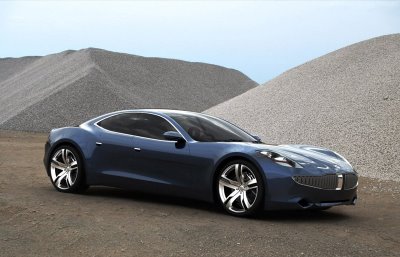
The problem remains, that the Fisker still panders to the failed model of urban sprawl- it's fundamentally a conventional, private, vehicle. The stackable cars below are a brilliant means of city mobility (if only they were half as wide, twice as long to really throw out conventional spatial wisdom), in combination with mass transit. I'd love to see a dedicated, traffic-calmed series of lanes designed for real integration of these vehicles. The Aptera would fit right in, as would the Loremo.
'IRVINE, Calif. Oct. 31, 2007: Quantum Technologies, a publicly traded company
(QTWW) and Fisker Coachbuild, LLC disclose continuing developments of the first
production vehicle to come from Fisker Automotive, Inc. - the green American
premium car company. The four-door plug-in hybrid premium sports sedan will
make its debut at the Detroit Auto Show in January with a starting price of $80,000.
Initial deliveries will commence in the 4th quarter of 2009 with annual production
projected to reach 15,000 cars....
Performance details for the first car are impressive achieving 50 miles (80
kilometers) on a pure electric charge. Additionally, by further utilizing a gasoline or
diesel engine offered by Fisker, one can extend the total range of their Fisker to more
than 620 miles (1000 kilometers). The first Fisker will also deliver an extraordinary
100 miles per gallon - performance figures that will ultimately help to reduce the
need for the importation of foreign oil.'
The problem remains, that the Fisker still panders to the failed model of urban sprawl- it's fundamentally a conventional, private, vehicle. The stackable cars below are a brilliant means of city mobility (if only they were half as wide, twice as long to really throw out conventional spatial wisdom), in combination with mass transit. I'd love to see a dedicated, traffic-calmed series of lanes designed for real integration of these vehicles. The Aptera would fit right in, as would the Loremo.
Saturday, November 03, 2007
Carbon-free, stackable rental cars
Combined with a sustainable supply of energy for recharging, the stacked-rent-a-car idea looks really appealing. Although mass public transport is superior, this could provide a stepping stone in the right direction. Especially in cities such as Auckland which have such a car-centric infrastructure already in place, it could be the key in convincing people to rid themselves of their metal beasts. I for one would find this a huge help (and most likely, very economical). I could sell my infrequently used car and save myself all the associated maintenance & running costs but still have access to such a mode of transport.

Via Engadget. See Technology review for more info.
A group of researchers at MIT have been hard at work developing a solution that's kind on the planet and your scrawny legs. A team called Smart Cities have designed a small, two-seat, electric vehicle -- which they call the City Car -- that can be "stacked" in convenient locations (say, just outside a subway stop), and then taken on short trips around urban areas. The cars -- which are based around an omnidirectional "robot wheel" that encases an electric motor, suspension, and steering -- can be "folded" and attached to a group of other cars for charging. The lineups of rentable vehicles would be accessible from various points around a city, with six or eight cars occupying just a single "regular" car space
Via Engadget. See Technology review for more info.
Monday, October 08, 2007
"....We have the option of letting the remaining resources of the planet be fought over viciously through militarized power or we can move rapidly to the ability to rebuild our ecosystems, share the limited resources the planet can provide us, and create good lives while doing it. But to do that, we'll have to get out of many reductionisms.
The first reductionism being the reductionism of energy. We've suddenly moved to thinking of energy as something we can consume, not as something we generate. And I think that generative concept of energy -- we call it shakti in India -- is something we have to reclaim, because the solution to pollution and wasted people is bringing people back -- deep into the equation of how we produce things, how we work the land, how we shape community, and how we exercise our democratic rights and rebuild our freedoms."
Vandana Shiva
The first reductionism being the reductionism of energy. We've suddenly moved to thinking of energy as something we can consume, not as something we generate. And I think that generative concept of energy -- we call it shakti in India -- is something we have to reclaim, because the solution to pollution and wasted people is bringing people back -- deep into the equation of how we produce things, how we work the land, how we shape community, and how we exercise our democratic rights and rebuild our freedoms."
Vandana Shiva
Mitsi i EV
Mitsubishi's new i Car is an excellent piece of design thought- only slightly longer than a Smart Fourtwo, but with seating for 4, and looks like something straight out of Ghost in the Shell..
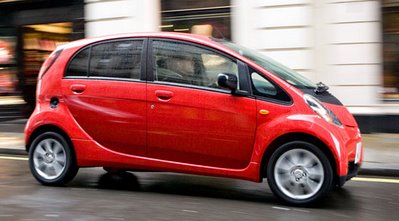
An all-electric version has just been unveiled, for possible delivery next year. This seems like the most practical all-electric vehicle yet- a range of 100 miles, charge time of 7 hours, but 80% charge in half that time. A specialised quick-charge unit will provide 80% charge in half an hour, so de-centralised charging stations are a possibility. Top speed is 80 mph, the electric version actually provides twice the torque of the petrol version, and slightly more power. Overall energy costs are expected to be between a third and a ninth of the petrol engine. Price estimated to be circa UK£15,000, or at today's exchange rate, ~NZ$40,200.
Meridian Energy has discussed electric car trials, the i EV would be a superb candidate. If Mitsubishi released a lease deal here, I'd seriously consider taking it up in our single-car-household domestic arrangments (we'd need an off-street garage though)!
Edit: I've never been a strong proponent of modern hybrid cars, they appear to be a clever marketing halo for their respective brands rather than a hugely positive step forwards. Substituting visible, operational energy efficiency (in a narrow window of use, furthermore) for truly reductionist thinking. Here is the most recent list of overall, cradle-to-grave energy use by cars on the UK market.
'Conventionally engined superminis dominate the top ranks. The scientists gave half their score based on each cars' emissions of CO2, NOx and other pollutants; the other half of the score was calculated from vehicles' construction, energy costs, recyclability and size. The higher the score, the cleaner the car:
• 1st Smart Roadster - 66.2 points
• 2nd Smart Fortwo Cabriolet - 59.8
• 3rd Citroen C1 1.0 - 40.1
• 4th Peugeot 107 1.0 - 38.6
• 5th Citroen C1 1.4 HDI - 31.3
• 6th Fiat Panda 1.2 Dualogic - 28.4
• 7th Ford Ka 1.3 - 27.5
• 8th Toyota Yaris 1.0 - 27.2
• 9th Fiat Panda 100hp - 23.6
• 10th Pegueot 206 1.4 - 23.5
• 11th Mini Cooper D - 23.3
• 12th Toyota Prius 1.5 - 23.2'
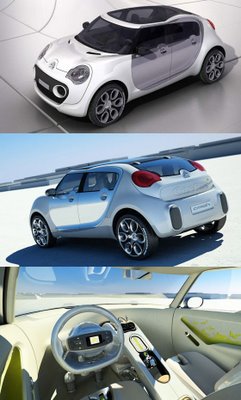
By far the most interesting, avant-garde approach to small cars recently is the 83 MPG Citroen C-Cactus.
Photos courtesy of CAR
Friday, July 20, 2007
Wall House

I've always really loved buildings which incorporate textiles into their construction. The Wall House, by Frohn & Rojas, is described as a 'design investigation into how the qualitative aspects of the wall, as a complex membrane, structure our social interactions and climatic relationships and enable specific ecologies to develop. The project breaks down the “traditional” walls of a house into a series of four delaminated layers ( concrete cave, stacked shelving, milky shell, soft skin ) in between which the different spaces of the house slip.'
The outer layer of the house consists of a skin derived from greenhouse technology, which climatically controls the interior and provides diffused light. There's a lovely balance between the skin, the slightly more permanent wood, and the concrete base underlying the project. It's quite a nice thought that eventually the skins might be modified to contain photovoltaic porphyrin dyes....
Thursday, July 19, 2007
Foster + Partner's Siberian Tower

From Norman Foster + Partners- in Khanty Mansyisk, Siberia, a 280m tall mixed-use tower. The overall scheme entails twin podiums containing residential, retail, office and hotel space. The tower itself refracts and directs natural sunlight in the winter months, via the beautfiul crystalline faceting. Truly inspiring.
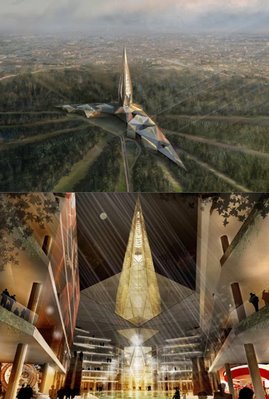
I'm practically breathing microscale wind turbines at present, so I'm slightly disappointed the tower has none. Nonetheless, there are some aesthetic imperatives shared by the concept I'm working on and the structure above.
From Foster + Partners
Friday, June 29, 2007
Tank Farm revisited
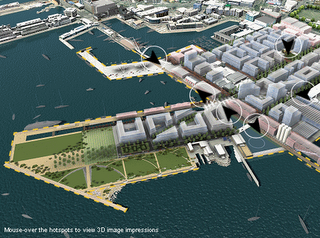
Over a year ago we posted on the initial design proposal for Auckland's Tank Farm.
After public consultation and some tweaking, a revised plan is now up and apparently has the go-ahead.
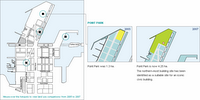
Extensive public feedback and ongoing discussions with key stakeholders have led to the following key changes:
For a comprehensive rundown of the design check out www.tankfarm.co.nz
Looks like 2008 onwards will be busy years of construction for Auckland. I still quite like the overall design proposal, and the addition of more public space and potential for a iconic building is very promising. Lets hope they get it right.
After public consultation and some tweaking, a revised plan is now up and apparently has the go-ahead.

Extensive public feedback and ongoing discussions with key stakeholders have led to the following key changes:
- the location and extent of public space
- the potential for an iconic building site at the northern point
- the nature and extent of Daldy Street Linear Park
- the capacity to enable the city to host marine events
- increased land for the established marine industries.

For a comprehensive rundown of the design check out www.tankfarm.co.nz
Looks like 2008 onwards will be busy years of construction for Auckland. I still quite like the overall design proposal, and the addition of more public space and potential for a iconic building is very promising. Lets hope they get it right.
Thursday, May 24, 2007
A ‘Green Powerhouse' in Dubai
 A little bit marketing splurlg and still to be tested in actual practical use, but interesting concept:
"The Dynamic Architecture building, which will be constantly in motion changing its shape, will be able to generate electric energy for itself as well as for other buildings. Forty-eight wind turbines fitted between each rotating floors as well as the solar panels positioned on the roof of the building will produce energy from wind and the sunlight, with no pollution. The total energy produced by this inbuilt ‘powerhouse' every year will be worth approximately seven million dollars."
"Each turbine can produce 0.3 megawatt of electricity, compared to 1-1.5 megawatt generated by a normal vertical turbine (windmill). Considering that Dubai gets 4,000 wind hours annually, the turbines incorporated into the building can generate 1,200,000 kilowatt-hour of energy."
"The horizontal turbines of the Dynamic Architecture building are simply inserted between the floors, practically invisible. They neither need a pole nor a concrete foundation. In addition, they are at zero distance from the consumer, making also the maintenance much easier. The particular design of the building and the carbon fiber special shape of the wings take care of the acoustics issues. Producing that much electric energy without any implication on the aesthetic aspect of the building is a revolutionary step in tapping alternative energy sources. This production of green energy will have a positive impact on the environment and economy."
http://www.dynamicarchitecture.net
Related to this, a novel idea for eliminating floor-envy in businesses. Reminds me, as also mentioned in the post of the Stairway I visited in a Loire Castle in France. It is strange how you never realise, once inside the spiral that there are two levels to it.

Read the post on the a 1D skyscraper with a single corridor here
Monday, May 21, 2007
Eco Auckland - The cold, hard facts
- Pollution from vehicles alone accounts for an estimated 250 premature deaths in Auckland every year.
- Every month the Auckland region creates enough rubbish to fill a rugby field to over the height of a 10-storey building.
- Each year over 85,000 tonnes of sediment enters our streams, lakes, estuaries and harbours. In Auckland, sediment is the biggest cause of shellfish die-off in estuarine environments.
- Auckland is the weediest city in the Southern Hemisphere.
- Only 12% of our total land area in the Auckland region is native forest. (this isn't that bad I think)
- The Auckland region has 56 threatened animal species and 105 threatened plant species.
- 80% of peak hour cars only have the one driver in them. (Count me in..)
- It is estimated that over 45,000 cigarette butts enter out harbour every day. Each year 25 million cigarette butts are washed into the sea. (people trowing their butts out the window while driving. grrrr)
- Every year over 1000 native fish are killed as a result of storm water pollution.
- New Zealanders use over 22 million plastic bags each week and about 800 million plastic bags a year, most of which end up in the landfill. Plastic bags will take 500 years to break down.
- Taken from citymix magazine, September 2006
Sunday, May 20, 2007
Wind turbines & hair dryers

Would a move to renewable energy incite a change of lifestyle or a change of lifestyle lead a move to renewable?
Should we reconsider & redesign the process and products used for drying hair? It might allow for a large uptake in sustainable, micro-generation schemes.
Political myth-busting and making over at Daily Mail
From Expedition's blog, who comment:
Now I pose the question, do I a) be please that the online readership of the Daily Mail are discussing such issues, or b) scream at the simplistic understanding of these people?
Thursday, May 17, 2007
On the Aesthetics of Wind Farms
 An interesting discussion over at Design Observer on the Aesthetics of Wind Farms.
"What is beauty and how does it relate to ecology? A look at contrasting aesthetic intuitions about wind farms reveals a paradigm shift in how we understand beauty. Our sense of the nature of beauty cannot be separated from our sense of the beauty of nature."
"In nature, there is no distinction between function and ornamentation. The opposite of wholeness is not ornamentation but fragmentation. Ugliness is the perception of fragmentation. Alienation is a form of fragmentation."
Read the full article here
Monday, May 14, 2007
City of Sprawl
Electrified rail provides passenger movements equivalent to 7 lanes of traffic, with 10 times the peak capacity of current motorway systems!
It's frustrating most of the line is already in place, with electrification being of the essence for an effective modern system. While Wellington isn't quite as linear as Auckland, it's looking increasingly unlikely we'll soon see urban rail either.
Thanks for posting the videos, really worthwhile.
Here's an interesting debate between Tom Beard, and some local Rand-droids
It's frustrating most of the line is already in place, with electrification being of the essence for an effective modern system. While Wellington isn't quite as linear as Auckland, it's looking increasingly unlikely we'll soon see urban rail either.
Thanks for posting the videos, really worthwhile.
Here's an interesting debate between Tom Beard, and some local Rand-droids
Sunday, May 13, 2007
Wednesday, March 07, 2007
Wind Kinetics
I've started an R&D blog for my kinetic wind-sculpture. I'll use it as a more detailed journal of the process, so comments and critique would be much appreciated. Relevant updates will be posted here simultaneously.
Friday, February 16, 2007
Auckland : City of Cars - Episode 1
"A documentary series on Auckland's transport problems, and exposes a number of "urban myths" about why it cannot be changed."
Wednesday, January 31, 2007
Architecture 2030
Over at the ever-essential BLDGBLOG, Geoff Manaugh interviews Ed Mazria of Architecture 2030. Required reading....
Also related, G. Monbiot has published an essay, The New Friends of The Earth?, a nice antidote to earnest attempts to convince us that continued consumption, if green enough, will save the world:
"But there is a bigger contradiction than this, which has been overlooked by both the supermarkets and many of their critics. “The green movement,” Terry Leahy tells us, “must become a mass movement in green consumption.” But what about consuming less? Less is the one thing the superstores cannot sell us. As further efficiencies become harder to extract, their growth will eventually outstrip all their reductions in the use of energy. This is not Tesco’s problem alone: the green movement’s economic alternatives still lack force.
The big retailers are competing to convince us that they are greener than their rivals, and this should make us glad. But we still need governments, and we still need campaigners."
On a purely linguistic note, why must writers insist on using 'green' as a verb? so gauche..
Also related, G. Monbiot has published an essay, The New Friends of The Earth?, a nice antidote to earnest attempts to convince us that continued consumption, if green enough, will save the world:
"But there is a bigger contradiction than this, which has been overlooked by both the supermarkets and many of their critics. “The green movement,” Terry Leahy tells us, “must become a mass movement in green consumption.” But what about consuming less? Less is the one thing the superstores cannot sell us. As further efficiencies become harder to extract, their growth will eventually outstrip all their reductions in the use of energy. This is not Tesco’s problem alone: the green movement’s economic alternatives still lack force.
The big retailers are competing to convince us that they are greener than their rivals, and this should make us glad. But we still need governments, and we still need campaigners."
On a purely linguistic note, why must writers insist on using 'green' as a verb? so gauche..
Monday, January 29, 2007
World Wetlands Day
February the 2nd is World Wetlands Day, and an exhibition is being held at Waitangi Park. The artificial wetlands there are a beautiful model for how our own landscaping might progress, so I anticipate the talks should be very interesting.
Friday, January 26, 2007
Some quick updates from Sustainable Future.
Greenpeace has released their 2007 Global Energy Report. It's a great source of research data on the decentralisation of energy supply resources. Wonderful to see substantial projections of our possibilities.
"But now, four and a half billion years after the formation of the planet, nearly four billion years since the emergence of life on Earth, after five major extinction events, a single species is responsible for much of planet’s destiny. A species that through the power of its technology, the sheer size of its biomass, its ever-expanding energy and resource requirements, has changed the course of our planet’s history forever. And that species is, of course, us. The choices that we make now and in the future will have an effect on life on Earth just as great as that asteroid 65 million years ago. "
"Some of the measures needed to combat climate change may be incompatible with the WTO. For example the European Union is currently looking at introducing a border tax against energy intensive goods coming from countries that have not made commitments to reduce their greenhouse emissions. After all why should European companies internalise the cost of greenhouse emissions while American companies continue to pollute for free? If American companies can get away with polluting the planet for free then what’s to stop European companies moving to the US and simply exporting their products into Europe? Hence they need a climate protecting border tax to even up the playing field. But such a climate border tax may be against the rules of the WTO, as a restriction on trade. "
Excerpts from Courage and Climate Change by Russel Norman, Green Party Co-Leader. Third Annual State of the Planet Speech
Greenpeace has released their 2007 Global Energy Report. It's a great source of research data on the decentralisation of energy supply resources. Wonderful to see substantial projections of our possibilities.
__
"But now, four and a half billion years after the formation of the planet, nearly four billion years since the emergence of life on Earth, after five major extinction events, a single species is responsible for much of planet’s destiny. A species that through the power of its technology, the sheer size of its biomass, its ever-expanding energy and resource requirements, has changed the course of our planet’s history forever. And that species is, of course, us. The choices that we make now and in the future will have an effect on life on Earth just as great as that asteroid 65 million years ago. "
"Some of the measures needed to combat climate change may be incompatible with the WTO. For example the European Union is currently looking at introducing a border tax against energy intensive goods coming from countries that have not made commitments to reduce their greenhouse emissions. After all why should European companies internalise the cost of greenhouse emissions while American companies continue to pollute for free? If American companies can get away with polluting the planet for free then what’s to stop European companies moving to the US and simply exporting their products into Europe? Hence they need a climate protecting border tax to even up the playing field. But such a climate border tax may be against the rules of the WTO, as a restriction on trade. "
Excerpts from Courage and Climate Change by Russel Norman, Green Party Co-Leader. Third Annual State of the Planet Speech
Subscribe to:
Posts (Atom)