Saturday, February 25, 2006

A Free Ride?

Some more exploration of a dual-mode electric motor/generator. Shown is an updated sketch of an enclosed motorcycle- I quite like the styling possibilities presented by the format.

Further to the motorcycle itself, is where the dual use part comes in. An idea is to run drums on axles, covered with rubber, in small trenches in carparks. The axles would be fitted with a differential, which would in turn receive drive from a small wind-turbine, via a gearbox.

The whole point is that the vehicles are sitting for most of the day, all their components unused- commuters all travel within fairly specific windows of time.

In this situation, vehicles would position their drive wheels in such a way as to take torque from the rotating drums, the motors would be reversed and engaged as generators- this would save manufacturing and installing extra generators to charge the vehicles anyway. The electricity produced over the 8 hours or so that the vehicles are parked could either go towards re-charging their cells, the logical outcome, or fed back into the grid.

Because the installation of the car-park components is fairly simple, with no integral generator, the wind turbines themselves could be fairly simple. My initial idea was to have a conventional propellor blade, at a safe height, but this would require two differentials- and a lot of mechanical loss. Instead, a vertical axis turbine would be better suited- less complexity, and could be more efficiently constructed, inexpensively with very lightweight materials, ie. like a sail. Of course, each section of ground drums would have drive from only one turbine- they would always be turning at a different rate. Gearing would ensure that the resistance from the vehicles was not so great as to stall the aerodynamics- the full weight would not be supported by the drums either, just enough to maintain enough turning friction. A lot of detail must be worked through- safety, capacity for larger vehicles etc. but I think there could be some promise here.

Edit: A waterwheel would of course be the most efficient way to apply drive, as it would not require a differential. Could this be set up in downtown areas to take advantage of harbour currents? tide changes?

Friday, February 24, 2006

The phytoplankton of transport modes....


A very quick layout exploration of personal transport, that is, the modal means to convey oneself to a public transport node. Two-passenger personal transport vehicles could also be accepted into ultra-urban, traffic calmed areas, as they would be far closer in footprint to a motorcycle.

This example is basically an enclosed motorcycle, with automatic outrigger retractable wheels for low speed stability. The overall arrangment is far closer to optimum modal efficiency than a conventional car. If more modal time was spent in low-speed, traffic calmed areas, then a tilting 3-wheeler would be more effective in operation, the trade-off being higher complexity. I intend a number of 2 - 4 seat personal transport vehicle concepts and scenarios will be developed through the duration of my thesis.

Thursday, February 23, 2006

Habitat Hotel

This is right down your alley, Nilut....
Interactive architecture responding to renewable energy collection- amazingly elegant.

Wednesday, February 22, 2006

Convoluted?


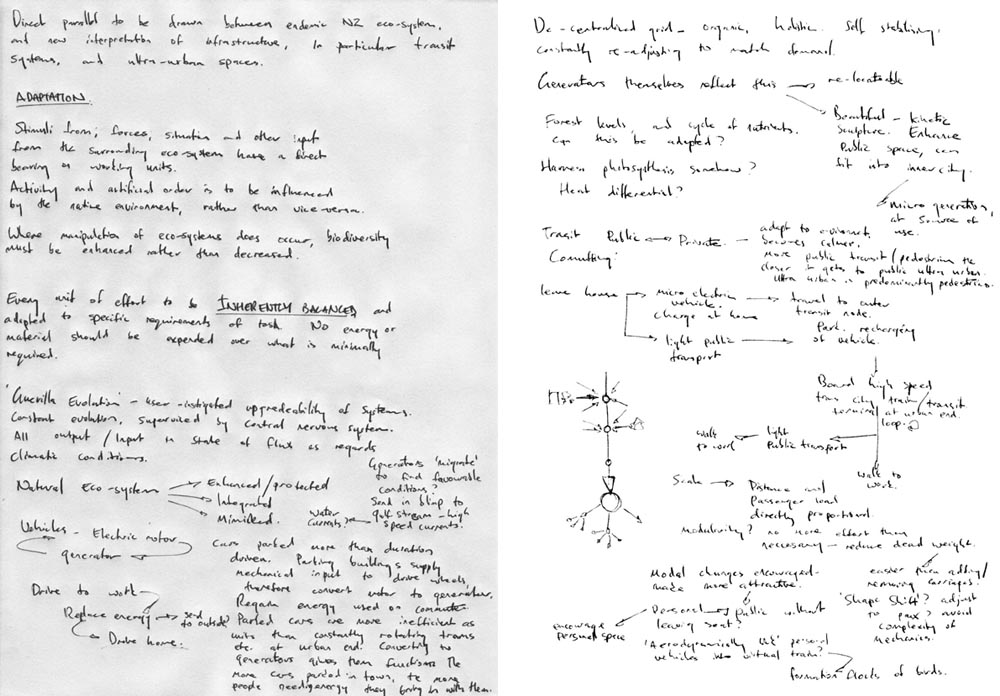
We are definitely onto some similar ideas- Here are an initial few pages I scribbled up yesterday. Inherently self-stabilising systems, and the idea of total interrelation seem to be a common thread- I would really like to push the bio-mimicry within this, particularly where evolutionary adaptation is concerned. Darwin first postulated that evolution occured primarily as a reaction to environmental challenges, while some Neo-Darwinian thinkers suggested a further function, direct manipulation of the environment itself to benefit the organism in question. On a different level, a practical application would once again see human infrastructure adapt firstly to the environment- if the state of the biosphere deteriorates further then manipulation of nature will be proven as lessening our chances to survive as a species.

Resilience

I came across this company, Resilience Alliance, by accident, but it deals with the approach I would like to take. Fundamentally, my thesis will deal with the inherent order and adaptive quality of the New Zealand endemic ecosystem, and translate it to an infrastructure and transit system for the urban environment. I intend to redefine the relationship between the biosphere and artifice, so that infrastructure adapts to the natural environment itself, as opposed to modifying the landscape to our own ends. As an example, it has always fascinated me that New Zealand's journey from Gondwana created an inland ecosystem which, in higher level flora and fauna, is almost entirely based on a variety of landscapes and vegetation (mainly temperate rainforest), and birdlife. Environmental adaptation in a most pure form. It is clear how easy it is to tip the balance, when presented with the arrival of introduced mammals: rats, cats, dogs, possums etc- Current urban infrastructure is a great big possum. But not as fluffy.

Diversity of endemic species must be maintained, and in fact re-established on the mainland. Evolution has provided each example of flora and fauna with functionality perfectly attuned to the environment around it- nothing is superfluous in this form of response [Edit, I do not intend to describe evolution as design per se....] to operational requirements. Therefore, species must be re-introduced where they have a positive symbiotic relationship with the biosphere. This symbiois will be the basis for my research, both enhanced in it's own right, and used as a basis for an urban system.

The challenge will be to keep the balance between utopia and reality.

Saturday, February 18, 2006

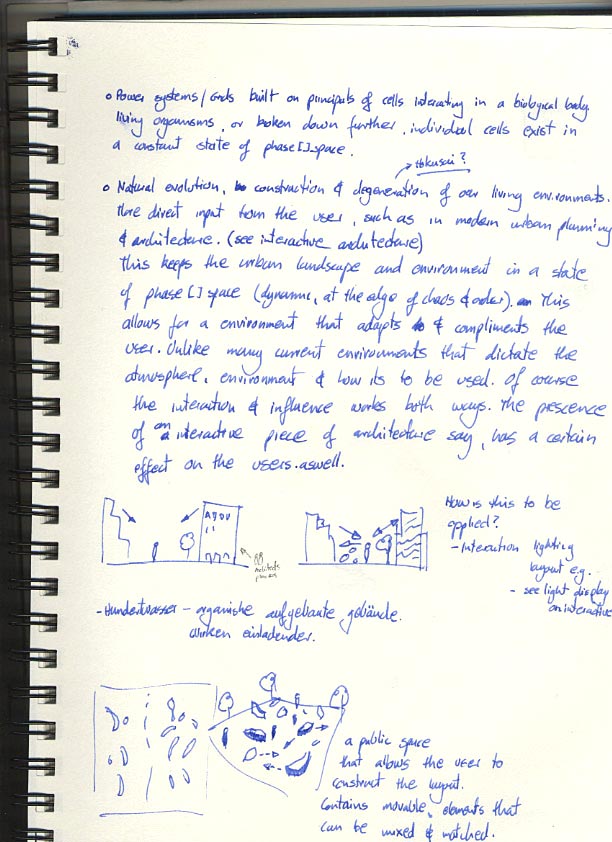
phase[ ]space - concepting

As promissed, some thoughts (Albeit highly unfinished and fragmented) on general systems, related to a follow on to my past research on complexity theory. Using it more as a general thought approach than a mathematical, scientifically sound theorem.
The scans show some throught processes, that may or may not reveal what I'm getting at. I hope they are somewhat legible.
I will work this a little further and see If I can come up with a little more meat.

Untill then..

Friday, February 10, 2006

Oil free economys

A brave move by Sweden towards a new energy economy by setting itself a 15 year limit to switch to renewable sources. Although the main replacement looks to be bio-fuels (ethanol) from its massive forests, which leading on from your previous post is not looking like a cure.

However it is exiting to see bold initiatives like this. If they ever get realised remains to be seen. (A 1980 referendum to phase out nuclear power is still not finalised)

Other interesting activity:

"The decision to abandon oil puts Sweden at the top of the world green league table. Iceland hopes by 2050 to power all its cars and boats with hydrogen made from electricity drawn from renewable resources, and Brazil intends to power 80% of its transport fleet with ethanol derived mainly from sugar cane within five years."

http://business.guardian.co.uk/story/0,,1705315,00.html

Wednesday, February 01, 2006

An Interesting Comparison

Fuell cell vehicles have always intruiged me, in that they appear to be an environmentally credible way to continue using internal combustion engines into the long term. Despite the fundamentally anti-social nature of a Ferrari V-12, I would hate to never hear one again....

However, really looking at the benefits of still unattainable fuell cells when compared to already existing electric mediums is quite a revelation. What it comes down to is the fact that hydrogen must be split from water, using electricity, then after a rather technically difficult storage either recombined with oxygen through combustion, or within the cell itself, giving off electricity again: fuell cells are of course a direct analouge to an electric cell, dealing with a gas which is extremely hard to store without loss. Which is why an electric cell is inherently more efficient- the electricity can be sent straight to the cell, instead of being first used in hydrolysis. The mechanical process is massively reduced, and therefore net losses are as well.

For 79 Kwh from an electricity source, through the transimission lines (92% efficient) and charger (89% efficient), to the lithium ion battery (94% efficient) and hub-mounted brushless motors (89% efficient), we end up with 60Kwh at the wheels.

For 202 Kwh from an electricity source, with electolyisis (72% efficient) through a pipeline (86% efficient) providing a fuell cell (54% efficient) with hydrogen, the same motors (89% efficient) will again provide the same 60Kwh at the wheels.

This is not to mention the fact that the infrastructure is in place to support electric vehicles. Generation can be added to the grid, and the system I postulated recently would suit domestic use particularly well.

Of course, the petro-chemical empires will push for the establishment of a hydrogen economy, because privatised filling stations will earn you a large profit, and plugging cars in to the mains at home won't.

One can only hope that electric cells can be made slightly less environmentally reprehensible. Imagine the end of life waste if every car was powered by lithium ion batteries....

http://www.worldchanging.com/archives/002685.html
An article (followed by heated discussion) with regard to the efficiency of hydrogen fuell cells versus electric vehicles.

http://www.metricmind.com/data/bevs_vs_fcvs.pdf
Technical data with compelling evidence. The flow chart is of particular interest.

Tuesday, January 31, 2006

a Red Herring

Why Biofuels are absolutely NOT a sustainable option.

George Monbiot writing in The Guardian.

"The demand for biodiesel," the Malaysian Star reports, "will come from the European Community ... This fresh demand ... would, at the very least, take up most of Malaysia's crude palm oil inventories." Why? Because it is cheaper than biodiesel made from any other crop.

In September, Friends of the Earth published a report about the impact of palm oil production. "Between 1985 and 2000," it found, "the development of oil-palm plantations was responsible for an estimated 87 per cent of deforestation in Malaysia". In Sumatra and Borneo, some 4 million hectares of forest have been converted to palm farms. Now a further 6 million hectares are scheduled for clearance in Malaysia, and 16.5 million in Indonesia.

Before oil palms, which are small and scrubby, are planted, vast forest trees, containing a much greater store of carbon, must be felled and burnt. Having used up the drier lands, the plantations are moving into the swamp forests, which grow on peat. When they've cut the trees, the planters drain the ground. As the peat dries it oxidises, releasing even more carbon dioxide than the trees. In terms of its impact on both the local and global environments, palm biodiesel is more destructive than crude oil from Nigeria.

http://www.guardian.co.uk/comment/story/0,3604,1658898,00.html

Saturday, January 28, 2006

More Urban Planting


A very nice example of re-using exisiting structures. Friends of the High Line is a non-profit organization dedicated to the preservation and reuse of the High Line - a 1.5 mile, elevated railway that runs along the West Side of Manhattan. Preliminary designs are being devised that will allow this railway to be developed into a promenade.

http://www.thehighline.org/