I believe that a micro-grid network of small generators might have an excellent application within schemes such as this UNICEF one:
'Microcredit is the extension of small loans to groups of poor people, especially women, for the purpose of investing in self-employment programmes . It is a way of improving the earning capacity and therefore the standard of living of the poor. Nevertheless, a poor woman who generates income through microcredit but who does not have adequate access to health care for herself and her family, who lacks essential information about health and nutrition and who is unable to send her children to school is still living in poverty.
There is a greater reduction in poverty when microcredit programmes are combined with increased access to basic social services than when the programmes focus on credit alone.
When microcredit is linked with access to basic social services and key social development messages, the health and nutrition of borrowers' children -- particularly girls -- improves; school enrolment increases; safe water and sanitation use broadens. This combined approach, therefore, is an important strategy for achieving the year 2000 goals for children. Microcredit also empowers women, by enabling them to make economic decisions and become the source of increased household income. Experience shows that with the empowerment of women come significant improvements in children's survival rates, health, nutrition and development.'
The Grameen Bank operates a system similar to this in Bangladesh. Dr. Muhammed Yunus, founder of the micro-credit movement, won the 2006 Nobel peace prize as a result. His bank provides loans at an average of US$200 to people living in poverty, who don't qualify for bank loans. No collateral or credit history is required, instead an honour system comprises the standard to which individuals are held. There is a 99% repayment rate.
Approximately 94% of the bank is owned by its 6.6 million borrowers, six percent by the government of Bangladesh.
I always wanted to market the Turbine/PV hybrid as a piece of sculpture. Of course, some basic engineering principals must be adhered to first and foremost, but the profit-margin might be greatly increased simply through paying more attention to aesthetics than previously. This might classify as needless ornamentation, but in a world of ostentatious 'green' gestures would perhaps prove popular.
This (hopefully) higher profit margin would then be used to subsidise construction of turbines, which would be sold (or hopefully subsidised even further through grants) to situations like the above, at a reduced cost. If ornamentation could be further removed to allow a reduction in manufacture costs then this would be a factor. It is also worth remembering that the western world would consume so many more small turbines per capita, simply through relatively wasteful energy use. Every turbine sent to developing villages would go a lot further.
The UNICEF website above presents the wonderful example of a scheme in Andhra Pradesh:
In two districts of Andhra Pradesh, thousands of women come togeth er in small groups. They each save 1 rupee a day (currently $1 = 35.5 Indian rupees), pool their savings and rotate the sum among them selves for production and day-to-day needs and as a source of capital for micro-enterprises. The Development of Women and Children in Rural Areas (DWCRA) scheme, supported by the Government and UNICEF, then extends further credit to the women once they have demonstrated their ability to form groups and save. Women are proud to display their passbooks and speak of their experiences.
In one village in Nellore District, for example, women have acquired land titles in their names and taken Rs180,000 as loans towards construction of their houses. They have said that they will not tolerate wife-beating and have forced their husbands to stop drinking alcohol. The longest-standing group in the village has rotated the revolving fund 25 times and also has a savings deposit of Rs30,000 in the bank. In another village, a group has saved Rs800,000. In total, the women of the district have mobilized savings of Rs60 million.
The women have used the revolving funds for productive activities, emergency consumption, health needs, marriages and children's education. The Total Literacy Campaign launched in the district in 1991 has brought education and information, with the savings groups becoming important centres for disseminating information on health, education, water and sanitation. There are visible changes in the health and nutrition of women and their children.
Thanks to Dina Mehta for her blog entry.
Tuesday, October 31, 2006

Thursday, October 19, 2006
Suuuu perrrr buuuuuusssss !!

An interesting electric bus concept, developed by Delft University of Technology. Only 1.7m high, so passengers cannot stand up internally, but wind resistance is much reduced- it can attain 250 km/h. I imagine something this sleek may attract people currently uninterested in buses, but if special roads are required to reach the top speed, how much more efficient is it than a high-speed train?
It comes down to the idea that you can travel at high speed on special lanes, and then use conventional roads to traverse stops at your city of destination, thus reducing modal changes. The direct comparison would be high speed rail, changing to conventional buses- although of course building the rail lines is far lower impact, and if you change modes, it immediately frees up the high speed transport to operate in its element. I'm not convinced this engorged-looking bus is the answer to a genuine question.
Wednesday, October 18, 2006
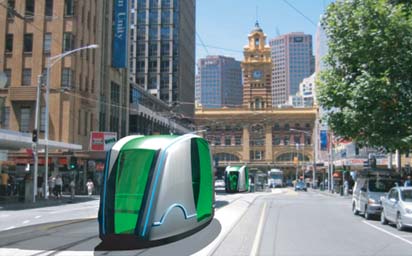
Melbourne 2020 – Single Track Tram System
The use of single-rail, gyroscope-stabilised vehicles, combined with stations between the lines, rather than outside the lines, addresses the narrow confines of many roads and the resultant traffic delays and associated air pollution arising from the present two-rail system.
Benjamin Last and Jess Cameron-Wootten
Monash University
> Link

Benjamin Last and Jess Cameron-Wootten
Monash University
> Link
Metropolis Energy Competition
I have been meening to get post this a while back, so without further delay & before I loose it completly...
This is a very appropriate competition currently run by the metropolis magazine. I belive we should seriously consider entering here. It does requiring a rather comprehensive submission with detailed proposal including a business plan.
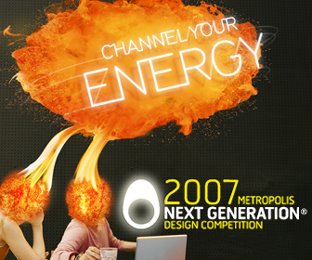
"The 2007 Next Generation® prize will finance the development of a bright idea that focuses on ENERGY, its uses, reduction, consumption, efficiencies, and alternatives. Intended to support designers whose entries reflect considerations of sustainability, distribution and manufacturing systems, economy, current technologies and materials, function, and provocative form and can speak to any one of the 6 sub-disciplines supported by the magazine"
I think this might be an interesting process to go through. Maybe we could look at putting together a submission around your micro solar/wind hybrid unit with an extension look at how this is integrated and interfaced with the home/user. This would give us a nice deadline to work towards aswell :-)
Link to website with details
Let me know what you think.
This is a very appropriate competition currently run by the metropolis magazine. I belive we should seriously consider entering here. It does requiring a rather comprehensive submission with detailed proposal including a business plan.

"The 2007 Next Generation® prize will finance the development of a bright idea that focuses on ENERGY, its uses, reduction, consumption, efficiencies, and alternatives. Intended to support designers whose entries reflect considerations of sustainability, distribution and manufacturing systems, economy, current technologies and materials, function, and provocative form and can speak to any one of the 6 sub-disciplines supported by the magazine"
I think this might be an interesting process to go through. Maybe we could look at putting together a submission around your micro solar/wind hybrid unit with an extension look at how this is integrated and interfaced with the home/user. This would give us a nice deadline to work towards aswell :-)
Link to website with details
Let me know what you think.
Thursday, October 12, 2006
Saturday, October 07, 2006
Dissertation Topic
I've been writing a research proposal detailing what I have planned for next year. Reviewing existing literature has really helped to provide a more realistic notion of what is possible with communal generation. The next stage is defining research goals and methods more concisely.
It looks like the bulk of my design work will surround the generator itself, most likely a micro solar/wind hybrid unit. However, I will also deal with the metering and wider system- with a view to working the whole arrangement into the Newer Zealand idea. In a really simple way, the generators are treated as revenue providing investments, the profits received then being used to pay off conventional power bills- the two processes effectively isolated. This means the turbines can be placed on off-site, optimal locations. It really becomes interesting when one imagines the repurcussions within an avant-garde urban dweller context, or metering which takes into account how much electricity (and profit) the investment is supplying, vs. how much electricity is being bought from the grid....
The University submission will be fairly technical, whilst the application within Newer Zealand will allow for a more conceptual interpretation. Leave a comment if you would like a copy of the research proposal sent to you.
It looks like the bulk of my design work will surround the generator itself, most likely a micro solar/wind hybrid unit. However, I will also deal with the metering and wider system- with a view to working the whole arrangement into the Newer Zealand idea. In a really simple way, the generators are treated as revenue providing investments, the profits received then being used to pay off conventional power bills- the two processes effectively isolated. This means the turbines can be placed on off-site, optimal locations. It really becomes interesting when one imagines the repurcussions within an avant-garde urban dweller context, or metering which takes into account how much electricity (and profit) the investment is supplying, vs. how much electricity is being bought from the grid....
The University submission will be fairly technical, whilst the application within Newer Zealand will allow for a more conceptual interpretation. Leave a comment if you would like a copy of the research proposal sent to you.
Thursday, September 07, 2006
Care to Change?
Hello, yes I'm still in existence.
I thought ill kick things off again a little by picking up a subject I had touched on in a previous post regarding societal commitment & change. The problem of grass root change & and acceptance for new processes.
Not a new problem, but very much worth taking into consideration in this context. No amount of planning, innovation & technology will succeed if the group asked to adopt these have no part in its conception & upkeep.
Sure you can say that in our current political & social model there are processes in place to involve the inhabitants in their environmental development. However I'm thinking more than merely voting on the new pattern of your local pavement in a council meeting. This would be more an intrinsic connection & feedback system with first, you direct environment such as your home (the personal phase[]space).
But coming back to the issue of the psychology of change. For all the innovation, technology & interactive feedback systems, it comes down to wether people can actually be bothered. You could take the approach of forced improvement, build the enhancements right into the product or system, so not using them is actually harder and more costly. A new car or office building is most likely more energy efficient without the user necessary having a desire for such properties. But this can only go so far and I believe that any considerable change requires more involvement. People have to care to change.
So how do you do that? How do you get Mr Bow Jones, driving his brand new red Holden SS, housed in an uninsulated oversize home to care about Co2 emissions, installing a wind generator and reducing his global footprint? The problem with the majority is not that they do not care, but that they probably just do not know any better. We are just too detached from our surroundings to realise the effect we are having on it. Being 'in tune with nature' is a key factor of environmental change for the better, be it through growing your own organic vegetables or being virtually synchronizing with the status of your surrounding. There needs to be some way to directly link inhabitants back into their surroundings. Our current societal model is built on the notion of having to 'conquer nature'. There is us, and then there is Nature which is intrinsically nasty, dangerous and out to get us.
I came across an interesting concept in 'Green Architecture' by James Wines. 'The system of totemic identity, as a condition of dualities where one's soul is shared by a self and an alter ego in nature, has intriguing implications for ecology'. The totemic identity was common in Aborginal culture, which has facinating human <> nature relationships (which in my mind are very much ahead of their time, so much so we still can't quite comprehend them). The Aboriginal totem acts as a conscience, guiding tribal and individual relationships with the natural environment. Quite how this can be applied yet I am not sure yet. However it relates well with my ideas of interactive phase[]spaces. It is about getting people to have a relationship with their surroundings, inviting involvement and direct improvement.
Totemic identiy could pose and excellent model of a societal monitoring system.
TBC
I thought ill kick things off again a little by picking up a subject I had touched on in a previous post regarding societal commitment & change. The problem of grass root change & and acceptance for new processes.
Not a new problem, but very much worth taking into consideration in this context. No amount of planning, innovation & technology will succeed if the group asked to adopt these have no part in its conception & upkeep.
Sure you can say that in our current political & social model there are processes in place to involve the inhabitants in their environmental development. However I'm thinking more than merely voting on the new pattern of your local pavement in a council meeting. This would be more an intrinsic connection & feedback system with first, you direct environment such as your home (the personal phase[]space).
But coming back to the issue of the psychology of change. For all the innovation, technology & interactive feedback systems, it comes down to wether people can actually be bothered. You could take the approach of forced improvement, build the enhancements right into the product or system, so not using them is actually harder and more costly. A new car or office building is most likely more energy efficient without the user necessary having a desire for such properties. But this can only go so far and I believe that any considerable change requires more involvement. People have to care to change.
So how do you do that? How do you get Mr Bow Jones, driving his brand new red Holden SS, housed in an uninsulated oversize home to care about Co2 emissions, installing a wind generator and reducing his global footprint? The problem with the majority is not that they do not care, but that they probably just do not know any better. We are just too detached from our surroundings to realise the effect we are having on it. Being 'in tune with nature' is a key factor of environmental change for the better, be it through growing your own organic vegetables or being virtually synchronizing with the status of your surrounding. There needs to be some way to directly link inhabitants back into their surroundings. Our current societal model is built on the notion of having to 'conquer nature'. There is us, and then there is Nature which is intrinsically nasty, dangerous and out to get us.
I came across an interesting concept in 'Green Architecture' by James Wines. 'The system of totemic identity, as a condition of dualities where one's soul is shared by a self and an alter ego in nature, has intriguing implications for ecology'. The totemic identity was common in Aborginal culture, which has facinating human <> nature relationships (which in my mind are very much ahead of their time, so much so we still can't quite comprehend them). The Aboriginal totem acts as a conscience, guiding tribal and individual relationships with the natural environment. Quite how this can be applied yet I am not sure yet. However it relates well with my ideas of interactive phase[]spaces. It is about getting people to have a relationship with their surroundings, inviting involvement and direct improvement.
Totemic identiy could pose and excellent model of a societal monitoring system.
TBC
Monday, July 10, 2006
More Interactive Cocoons
Some brilliant interactive architecture, Liquid 2.0, by Daan Roosegaarde.
How about an actual functional exhibition space modelled on an urban conceptualisation like this.... Perhaps we should be less literal- imagine this sort of thinking across a whole Newer Zealand. The implications for transport and farming are fascinating. A living surface which reconfigures itself completely during the middle of the day, when occupants are out and plants can recieve more sunlight. Or adapts to funnel the most wind energy to integral turbines. Highways based on the human neural pathways etc. I still like the idea of migrating living spaces. I expect your 20+ hours in an aluminium tube to be spent wisely....
How about an actual functional exhibition space modelled on an urban conceptualisation like this.... Perhaps we should be less literal- imagine this sort of thinking across a whole Newer Zealand. The implications for transport and farming are fascinating. A living surface which reconfigures itself completely during the middle of the day, when occupants are out and plants can recieve more sunlight. Or adapts to funnel the most wind energy to integral turbines. Highways based on the human neural pathways etc. I still like the idea of migrating living spaces. I expect your 20+ hours in an aluminium tube to be spent wisely....
Tuesday, June 27, 2006
Philip Beesley Architect

Fantastic work by Philip Beesley Architect, Toronto. Geo-morphic membranes which interact with their human occupants.
I particularly love Gill Array, Orpheus Filter, Reflexive Membranes and Orgone Reef.
Similar to my nesting idea, but abstracted by an order of magnitude and utterly beautiful. Article on BLDGBLOG
Sunday, June 11, 2006
Personal Rapid Transit
I haven't covered ULTra yet, as I have been quite undecided about the feasibility of the system. On the one hand, rapid transit would cut out the unused capacity of light rail, and fits into the concept of perfectly balanced units of energy expenditure. On the other, it appears over-complicated and not particularly versatile in real world operational conditions.
Part of my problem is the language of proponents of the system. The Wellingtonian, a local free paper, ran an article (June 8, 2006) where a backer states 'Wellintonians have a view that public transport is for 'losers' and that will not change by upgrading buses and trains.' There is a persisting capitalist assumption that personal rapid transit will succeed because the rest of society has an ego which precludes the use of 'loser' group public transport. However, this mindset appears to be akin to the idea that commuters currently have a god-given right to travel to work solo in giant SUVs. The key is to make public transport attractive, and I don't think anti-social, self-imposed isolationism is always the solution.
Further links:
Citizens for Personal Rapid Transit
PRT at Worldchanging - the comments section has some good debate.
Wiki -notice that 'The manufacturers of ULTra acknowledge that current forms of their system would provide insufficient capacity in high density areas such as central London, and that the investment costs for the tracks and stations are comparable to building new roads, making the current version of ULTra more suitable for suburbs and other moderate capacity applications'
The Wellington plan involves 6km of tracks, eventually spreading to the outer suburbs, so this follows the above.
The opponents of the scheme, however, do make a lot of sense. I particularly can see the likelihood of traffic jamming in the system. Rebuttal is here.
Overall, I can imagine PRT working in and around the various urban enclaves, in concert with high speed light rail to outlying urban areas, with the overall pax of the medium increasing as route length/demand does. Also, PRT gondolas need not look like a style-bereft fantasy of computer programmers, inspiration could be taken from Venice. The stations could be stunning, and the guiderails mounted on the ground anyway. Computer processing now exists to allow the system to flow where it previously failed, so I am fascinated to see how it works out in Cardiff. I would love to see this work, but remain sceptical.
Finally, a link to Charge. I have found this to be one of the most neutral, realistic websites out there debating future energy. The article follows my assesment of plug-in hybrids as the most suitable automotive energy source, and they see PRT as viable scheme.
Edit: Intruige!
A local has a blog with his own take on the situation. Great!
I am steering further into scepticism....
Part of my problem is the language of proponents of the system. The Wellingtonian, a local free paper, ran an article (June 8, 2006) where a backer states 'Wellintonians have a view that public transport is for 'losers' and that will not change by upgrading buses and trains.' There is a persisting capitalist assumption that personal rapid transit will succeed because the rest of society has an ego which precludes the use of 'loser' group public transport. However, this mindset appears to be akin to the idea that commuters currently have a god-given right to travel to work solo in giant SUVs. The key is to make public transport attractive, and I don't think anti-social, self-imposed isolationism is always the solution.
Further links:
Citizens for Personal Rapid Transit
PRT at Worldchanging - the comments section has some good debate.
Wiki -notice that 'The manufacturers of ULTra acknowledge that current forms of their system would provide insufficient capacity in high density areas such as central London, and that the investment costs for the tracks and stations are comparable to building new roads, making the current version of ULTra more suitable for suburbs and other moderate capacity applications'
The Wellington plan involves 6km of tracks, eventually spreading to the outer suburbs, so this follows the above.
The opponents of the scheme, however, do make a lot of sense. I particularly can see the likelihood of traffic jamming in the system. Rebuttal is here.
Overall, I can imagine PRT working in and around the various urban enclaves, in concert with high speed light rail to outlying urban areas, with the overall pax of the medium increasing as route length/demand does. Also, PRT gondolas need not look like a style-bereft fantasy of computer programmers, inspiration could be taken from Venice. The stations could be stunning, and the guiderails mounted on the ground anyway. Computer processing now exists to allow the system to flow where it previously failed, so I am fascinated to see how it works out in Cardiff. I would love to see this work, but remain sceptical.
Finally, a link to Charge. I have found this to be one of the most neutral, realistic websites out there debating future energy. The article follows my assesment of plug-in hybrids as the most suitable automotive energy source, and they see PRT as viable scheme.
Edit: Intruige!
A local has a blog with his own take on the situation. Great!
I am steering further into scepticism....
Subscribe to:
Posts (Atom)