Wednesday, March 07, 2007
Wind Kinetics
I've started an R&D blog for my kinetic wind-sculpture. I'll use it as a more detailed journal of the process, so comments and critique would be much appreciated. Relevant updates will be posted here simultaneously.

Friday, February 16, 2007
Auckland : City of Cars - Episode 1
"A documentary series on Auckland's transport problems, and exposes a number of "urban myths" about why it cannot be changed."
Wednesday, January 31, 2007
Architecture 2030
Over at the ever-essential BLDGBLOG, Geoff Manaugh interviews Ed Mazria of Architecture 2030. Required reading....
Also related, G. Monbiot has published an essay, The New Friends of The Earth?, a nice antidote to earnest attempts to convince us that continued consumption, if green enough, will save the world:
"But there is a bigger contradiction than this, which has been overlooked by both the supermarkets and many of their critics. “The green movement,” Terry Leahy tells us, “must become a mass movement in green consumption.” But what about consuming less? Less is the one thing the superstores cannot sell us. As further efficiencies become harder to extract, their growth will eventually outstrip all their reductions in the use of energy. This is not Tesco’s problem alone: the green movement’s economic alternatives still lack force.
The big retailers are competing to convince us that they are greener than their rivals, and this should make us glad. But we still need governments, and we still need campaigners."
On a purely linguistic note, why must writers insist on using 'green' as a verb? so gauche..
Also related, G. Monbiot has published an essay, The New Friends of The Earth?, a nice antidote to earnest attempts to convince us that continued consumption, if green enough, will save the world:
"But there is a bigger contradiction than this, which has been overlooked by both the supermarkets and many of their critics. “The green movement,” Terry Leahy tells us, “must become a mass movement in green consumption.” But what about consuming less? Less is the one thing the superstores cannot sell us. As further efficiencies become harder to extract, their growth will eventually outstrip all their reductions in the use of energy. This is not Tesco’s problem alone: the green movement’s economic alternatives still lack force.
The big retailers are competing to convince us that they are greener than their rivals, and this should make us glad. But we still need governments, and we still need campaigners."
On a purely linguistic note, why must writers insist on using 'green' as a verb? so gauche..
Monday, January 29, 2007
World Wetlands Day
February the 2nd is World Wetlands Day, and an exhibition is being held at Waitangi Park. The artificial wetlands there are a beautiful model for how our own landscaping might progress, so I anticipate the talks should be very interesting.
Friday, January 26, 2007
Some quick updates from Sustainable Future.
Greenpeace has released their 2007 Global Energy Report. It's a great source of research data on the decentralisation of energy supply resources. Wonderful to see substantial projections of our possibilities.
"But now, four and a half billion years after the formation of the planet, nearly four billion years since the emergence of life on Earth, after five major extinction events, a single species is responsible for much of planet’s destiny. A species that through the power of its technology, the sheer size of its biomass, its ever-expanding energy and resource requirements, has changed the course of our planet’s history forever. And that species is, of course, us. The choices that we make now and in the future will have an effect on life on Earth just as great as that asteroid 65 million years ago. "
"Some of the measures needed to combat climate change may be incompatible with the WTO. For example the European Union is currently looking at introducing a border tax against energy intensive goods coming from countries that have not made commitments to reduce their greenhouse emissions. After all why should European companies internalise the cost of greenhouse emissions while American companies continue to pollute for free? If American companies can get away with polluting the planet for free then what’s to stop European companies moving to the US and simply exporting their products into Europe? Hence they need a climate protecting border tax to even up the playing field. But such a climate border tax may be against the rules of the WTO, as a restriction on trade. "
Excerpts from Courage and Climate Change by Russel Norman, Green Party Co-Leader. Third Annual State of the Planet Speech
Greenpeace has released their 2007 Global Energy Report. It's a great source of research data on the decentralisation of energy supply resources. Wonderful to see substantial projections of our possibilities.
__
"But now, four and a half billion years after the formation of the planet, nearly four billion years since the emergence of life on Earth, after five major extinction events, a single species is responsible for much of planet’s destiny. A species that through the power of its technology, the sheer size of its biomass, its ever-expanding energy and resource requirements, has changed the course of our planet’s history forever. And that species is, of course, us. The choices that we make now and in the future will have an effect on life on Earth just as great as that asteroid 65 million years ago. "
"Some of the measures needed to combat climate change may be incompatible with the WTO. For example the European Union is currently looking at introducing a border tax against energy intensive goods coming from countries that have not made commitments to reduce their greenhouse emissions. After all why should European companies internalise the cost of greenhouse emissions while American companies continue to pollute for free? If American companies can get away with polluting the planet for free then what’s to stop European companies moving to the US and simply exporting their products into Europe? Hence they need a climate protecting border tax to even up the playing field. But such a climate border tax may be against the rules of the WTO, as a restriction on trade. "
Excerpts from Courage and Climate Change by Russel Norman, Green Party Co-Leader. Third Annual State of the Planet Speech
Habitation
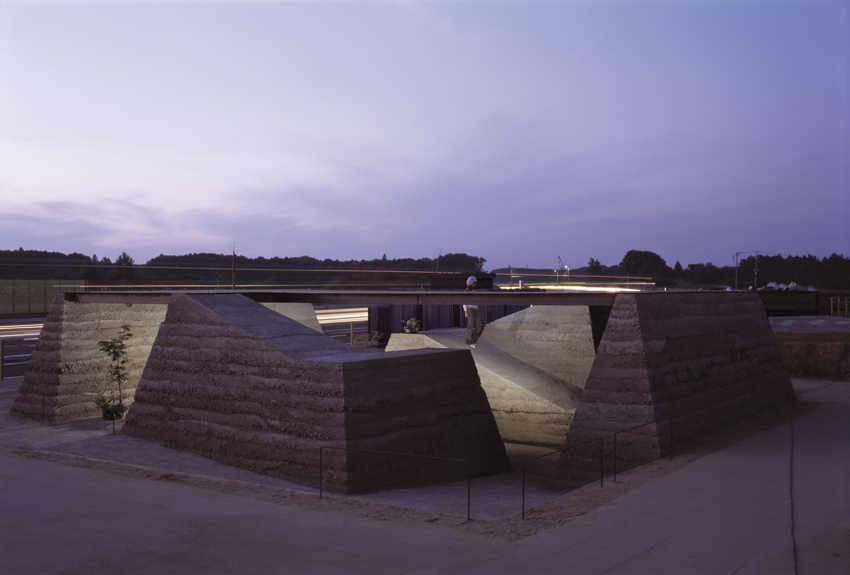
A few links further to my intended course of study this year. I’ll concentrate on the idea of modular housing (or rather the power supply thereof, more on that later), viewing small low-impact habitation from the perspective of an industrial designer.
Some interesting ideas involve structural walls which could be built from either rammed earth or straw bale (with timber framing). I really love the idea of manufacturing rammed earth surfaces on site, but using a set variety of jigs which could be reused indefinitely. With steel reinforcement, earthquake resistance is possible. I can’t find anyone that has tried carting rammed earth pieces around, reinforced or not, but if they are hard enough, sealed, and protected I can’t see any immediate issue. This is where consultation comes in!
Perhaps a hybrid of rammed earth and earth blocks (the same material, but dealing with the compression of earth into blocks rather than entire walls on site) would work? A series of interlocking panels extending from ground to stud, but perhaps 2m or so wide. They would need not support the roof completely, as the thermal mass they provide is a principal benefit in this context. All the power points and fixtures could be positioned between panels, leaving the rammed earth itself fairly low-tech. Wiring would need to be dealt with, but could again just run through panel gaps. Floors and ceilings would also suffice for plumbing etc- exposed copper piping would be a beautiful touch next to the patina of rammed earth. A spaceframe from timber or steel could support and lock into the earth panels, relieving them of a proportion of the structural stresses.
The beauty is that rammed earth is built ‘from’ the surroundings, so will revert to its natural state eventually. Adding concrete to the mix actually destabilises the structure, and prevents this cycle. You are faithful to the inherent nature of the surrounding material, and avoid shipping most of the eventual mass as you would a prefab. A prefabricated timber frame would support this construction where necessary. See also, Pise.
Some interesting ideas involve structural walls which could be built from either rammed earth or straw bale (with timber framing). I really love the idea of manufacturing rammed earth surfaces on site, but using a set variety of jigs which could be reused indefinitely. With steel reinforcement, earthquake resistance is possible. I can’t find anyone that has tried carting rammed earth pieces around, reinforced or not, but if they are hard enough, sealed, and protected I can’t see any immediate issue. This is where consultation comes in!
Perhaps a hybrid of rammed earth and earth blocks (the same material, but dealing with the compression of earth into blocks rather than entire walls on site) would work? A series of interlocking panels extending from ground to stud, but perhaps 2m or so wide. They would need not support the roof completely, as the thermal mass they provide is a principal benefit in this context. All the power points and fixtures could be positioned between panels, leaving the rammed earth itself fairly low-tech. Wiring would need to be dealt with, but could again just run through panel gaps. Floors and ceilings would also suffice for plumbing etc- exposed copper piping would be a beautiful touch next to the patina of rammed earth. A spaceframe from timber or steel could support and lock into the earth panels, relieving them of a proportion of the structural stresses.
The beauty is that rammed earth is built ‘from’ the surroundings, so will revert to its natural state eventually. Adding concrete to the mix actually destabilises the structure, and prevents this cycle. You are faithful to the inherent nature of the surrounding material, and avoid shipping most of the eventual mass as you would a prefab. A prefabricated timber frame would support this construction where necessary. See also, Pise.
Some inspirational Examples:
Red Hill Residence, Mornington Peninsula, Australia
Loco Architects, AR Awards for Emerging Architecture 2006, Tsukuba, Japan (photograph above)
Sunday, January 21, 2007
Some links [by Nikolai]
Here are some links that have really changed some of my recent thinking....
Vertical gardens. Beautiful. Surely this would work with any undulating impermeable sheet as a base? how about moulding parts of the sheet outwards through the foliage and concealing lamps within?
Paul Gipe interview.
Parlimentary Commission for the Environment on local energy systems: Of particular interest is this report on microgeneration potential in NZ, a parallel to my own literature review. It suggests that standalone small wind is not feasible where grid connection is assured (I postulated comparative costs, but moral superiority). However, the report finds favour in roof-mounted wind turbines of 1 - 1.5kw capacity, as a private relief on grid reliance. Most of my scepticism is founded on the structural stresses applied to buildings as well as inherent site turbulence, while the report cites noise as a primary liability. Some sort of cantilevered pole using the building as support would channel stresses, and I have some ideas for both turbulence (think splitter-plates in front of jet intakes on aircraft- I always knew a childhood obsession with aerodynamics would prove useful) and noise (wait and see, just remember most noise is caused by blade tip turbulence). In any event, if focusing on 1 - 1.5kw turbines, it would be vastly more practical to actually manufacture some sort of working prototype.
Finally, I implore you to purchase a copy of Endgame, by Derrick Jensen. I haven't read enough to write an analysis yet, but first impressions are of a similar approach to my own ranting vis the inherently destructive nature of our current productive-consumptive world order. Review Amazon page with reviews
Vertical gardens. Beautiful. Surely this would work with any undulating impermeable sheet as a base? how about moulding parts of the sheet outwards through the foliage and concealing lamps within?
Paul Gipe interview.
Parlimentary Commission for the Environment on local energy systems: Of particular interest is this report on microgeneration potential in NZ, a parallel to my own literature review. It suggests that standalone small wind is not feasible where grid connection is assured (I postulated comparative costs, but moral superiority). However, the report finds favour in roof-mounted wind turbines of 1 - 1.5kw capacity, as a private relief on grid reliance. Most of my scepticism is founded on the structural stresses applied to buildings as well as inherent site turbulence, while the report cites noise as a primary liability. Some sort of cantilevered pole using the building as support would channel stresses, and I have some ideas for both turbulence (think splitter-plates in front of jet intakes on aircraft- I always knew a childhood obsession with aerodynamics would prove useful) and noise (wait and see, just remember most noise is caused by blade tip turbulence). In any event, if focusing on 1 - 1.5kw turbines, it would be vastly more practical to actually manufacture some sort of working prototype.
Finally, I implore you to purchase a copy of Endgame, by Derrick Jensen. I haven't read enough to write an analysis yet, but first impressions are of a similar approach to my own ranting vis the inherently destructive nature of our current productive-consumptive world order. Review Amazon page with reviews
Wednesday, December 13, 2006
Thought for Christmas
Rev. Richard Randerson, in the most recent Listener (Dec. 16-22 2006), speaks about a thoughtful, intelligent, and non-literal reading of Genesis 1. Instead of a "pseudo scientific account of how the world came into being", he reads it as an allegorical "message of how we understand the world we live in. And for me, the key thing is that we live with a sense of interdependence. So all the parts of creation -the earth, the sea, the sky, the animals, the plants, the human species, live as a family and with a sense of mutuality and interdependence. The role of the human species is to act as stewards... it leads us to the concept of sustainability."
I think that is a really wonderful statement. It makes me profoundly proud to be an Atheist-Anglican who goes to the Holy Trinity Cathedral of Auckland every Christmas, the church where he is assistant Vicar. I'll think about Maui Dolphins and Kokako next time I listen to Berlioz's L'Adieu des Bergers sung by candlelight.
I think that is a really wonderful statement. It makes me profoundly proud to be an Atheist-Anglican who goes to the Holy Trinity Cathedral of Auckland every Christmas, the church where he is assistant Vicar. I'll think about Maui Dolphins and Kokako next time I listen to Berlioz's L'Adieu des Bergers sung by candlelight.
Tuesday, December 05, 2006
4-Seater Redux
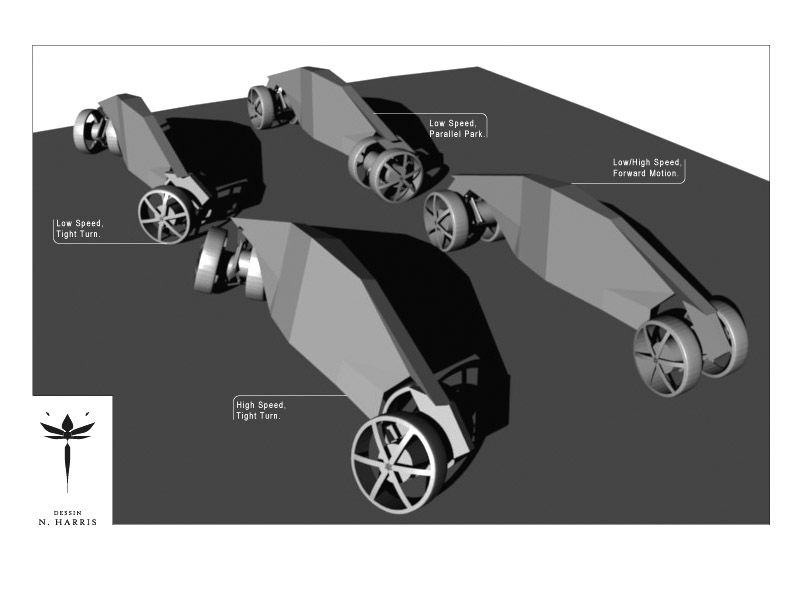

I spent last night re-engineering the 4-seater vehicle. For a number of reasons, I have decided to return to four thinner wheels rather than three wider. Various countries classify any 3-wheeled vehicle as a motorcycle, and thus require helmets; there is a degree of stability inherent in extra wheels, both longitudinally and in terms of cornering grip; the perception of enhanced safety etc.
Total width will remain at circa 1 metre, to take advantage of lane splitting and aerodynamics, with seating for 4. Construction, weight, and various other functional details remain similar.
The drivetrain consists of two units, almost like locomotive boogies. At low speeds, the units twist as a whole, both front and rear, to give a very tight turning circle. Either unit can rotate 90 degrees to allow parallel parking to become very simple- a specialised control would be required to switch into this mode.
At higher speeds, the units would continue to rotate on the horizontal plane, however a degree of tilt would be progressively applied via hydraulics. The tilt ratio would be determined in relation to speed, braking etc. by computer. Note also that the correct turning track for each wheel is provided by the differential built into the tilting mechanism- almost like giant skateboard trucks. Each wheel would have an electric motor positioned near the hub. I have avoided true hub-mounted motors as I believe unsprung weight is a real problem here, and they are actually quite impractical. Rather, these motors and their casings would function as the tilting arm attachment points, as well as the mounting point for suspension.
The resulting vehicle would have aerodynamics vastly superior to conventional cars, be just as safe, much, much lighter, more practical in urban areas, and hopefully even more exciting to drive. Efficiency would be excellent if using Li-ion cells.
A quick collection of links
There have been some excellent papers published by the Parlimentary Commissioner for the Environment. 'Future currents sketches two scenarios of New Zealand in 2015, 2030 and 2050 depending on today's energy choices. These scenarios are presented through the eyes of two fictional characters.'
Sustainable Future is an excellent New Zealand-based resource library, covering a wide array of sustainable news and articles. Very concise, and a valuable source of current information, laid out in specific topic areas.
Sustainable Energy Forum has some interesting links and papers, but most valuable are the PDF EnergyWatch magazines.
Transport.Org.NZ is a website dealing with NZ transport futures, mainly through well-chosen links.
Sustainable Future is an excellent New Zealand-based resource library, covering a wide array of sustainable news and articles. Very concise, and a valuable source of current information, laid out in specific topic areas.
Sustainable Energy Forum has some interesting links and papers, but most valuable are the PDF EnergyWatch magazines.
Transport.Org.NZ is a website dealing with NZ transport futures, mainly through well-chosen links.
Subscribe to:
Posts (Atom)